
Unlocking a Declining Asset: The ThermaCare Acquisition at Pfizer Consumer Healthcare
How deep market intelligence transformed a distressed brand into a peak-year sales outperformer — six months ahead of projections
Neel Tilak · Altitude Consulting
On paper, ThermaCare looked like a troubled asset. Sales were declining. The brand had lost momentum in its primary market. The seller was ready to move on. For many acquirers, the story ended there.
For the team at Pfizer Consumer Healthcare, it was the beginning of a much more interesting question: Why was the brand declining — and was that decline a permanent condition, or a correctable one?
The answer required something most acquisition teams don't do thoroughly enough: genuine market intelligence. Not a top-line review of category trends. A rigorous, multi-dimensional analysis of where the brand was underperforming, why it was underperforming, and what a better-positioned owner could do about it.
What the Numbers Didn't Show
Aggregate sales figures told one story. The market intelligence told three others — each pointing to a different kind of untapped potential that the current owner had either missed or lacked the capability to capture.
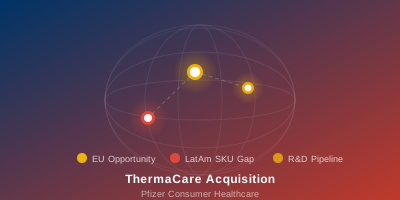
1. The EU Was Underutilized
A detailed geographic analysis revealed that ThermaCare's European footprint was significantly underdeveloped — not because consumers weren't interested, but because the product wasn't being presented through the right lens. In several key EU markets, consumer preference runs strongly toward external, localized pain relief rather than systemic analgesics. The cultural and behavioral disposition toward topical treatment was already there. ThermaCare — a heat therapy product applied directly to the site of pain — was a natural fit that had never been properly positioned or distributed to meet that demand. The opportunity wasn't to create new consumer behavior; it was to show up where existing behavior was already pointing.
2. Latin America Was Being Sold the Wrong SKUs
In Latin American markets, the team found a different kind of misalignment. The product was present, but the SKU architecture was wrong. The formats and pack sizes being sold didn't correspond to how consumers in those markets actually shopped or what they were willing to pay at point of purchase. Purchase intent existed — but conversion was being lost because the offer on shelf didn't match the decision being made in aisle. A realigned SKU strategy, calibrated to local purchase behavior rather than exported from the US playbook, represented a direct and near-term revenue opportunity requiring no new product development.
3. The R&D Pipeline Had Shelved the Wrong Assets
Perhaps the most consequential finding came from a thorough review of the seller's R&D pipeline. Two product variants had been developed and then shelved — deprioritized, most likely, because the incumbent owner lacked either the commercial conviction or the channel capability to bring them to market. The PCH team's analysis determined that these shelved formulations addressed product attributes that consumers had consistently flagged as important to purchase intent. Quantifying that gap, the team concluded that bringing these variants to market would improve purchase intent by approximately 45% — a figure that materially changed the long-term earnings model for the asset.
Acquiring not just the brand but the full associated infrastructure — including the R&D pipeline and manufacturing capabilities — was therefore not a cost; it was a strategic lever.
The Acquisition Thesis
With these insights in hand, the acquisition case was clear. ThermaCare wasn't a declining brand. It was a mismanaged one — held by an owner without the geographic reach, the SKU discipline, or the R&D commercialization capability to realize its potential. Pfizer Consumer Healthcare had all three, and a synergistic commercial infrastructure through its Advil franchise that could extend the brand's reach into the pain management category with a credibility no standalone player could replicate.
The team recommended the acquisition. The recommendation was accepted.
The Outcome
The results exceeded every benchmark set at the time of acquisition. Peak-year projected sales were achieved six months ahead of schedule. The new PCH ThermaCare team, working in close coordination with the Advil commercial organization, exceeded all revenue and growth targets — leveraging the brand synergies, the corrected geographic strategy, and the unlocked pipeline assets that the market intelligence had identified before a dollar of acquisition capital was committed.
The lesson is one that applies to any asset acquisition decision: the difference between a distressed asset and an undervalued one is almost always a function of the quality of the intelligence brought to the evaluation. ThermaCare looked like the former to its seller. With the right analysis, it was clearly the latter.
The three intelligence findings that made the case
- EU geographic gap: Existing consumer preference for localized pain relief was unmet — a positioning and distribution fix, not a demand creation problem
- Latin American SKU misalignment: Purchase intent existed but was lost at shelf due to wrong pack formats — addressable immediately without new product development
- Shelved R&D pipeline: Two deprioritized variants addressed the attributes consumers cared most about — bringing them to market projected to improve purchase intent by 45%
- Result: Peak-year sales achieved six months ahead of projection; all revenue and growth targets exceeded
Evaluating an asset and want an independent view of its true potential?
Schedule a Consultation